


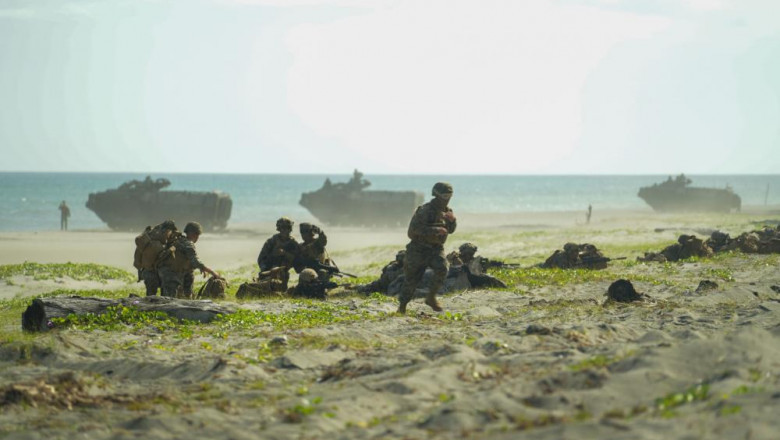

In a statement, U.S. Embassy in the Philippines Chargé d’Affaires ad interim Heather Variava said after two years of a global pandemic, U.S. and Philippine forces have come together to complete one of the largest Balikatan exercises ever held.
“This is a testament to the strength of the U.S.-Philippine alliance and the shared priorities of our countries,” she said.
For his part, U.S. Marine Corps Forces Pacific Deputy Commander Brig. Gen. Joseph Clearfield said the completion of yet another successful Balikatan is a clear example of the shared commitment to advancing peace and stability in the Indo-Pacific region.
“As a result of our mutual efforts, our militaries have grown together in friendship, and we are better prepared to respond as one cohesive team to any crisis or challenge,” Clearfield said.
Meanwhile, AFP exercise director Maj. Gen. Charlton Sean Gaerlan said the experience gained from exercise Balikatan complemented the country’s security cooperation endeavors and helped enhance existing mutual security efforts.
“Although there were limitations brought about by the pandemic, it is highly commendable that the exercise pushed through and generated a favorable outcome,” Gaerlan said.
In the past two weeks, about 9,000 participants from the AFP and U.S. military trained shoulder-to-shoulder from the northern coast of Luzon to Palawan, focusing on maritime security, amphibious operations, live-fire training, urban operations, aviation operations, counterterrorism, and humanitarian assistance and disaster relief.
U.S. and Philippine exercise forces employed more than 50 aircraft, four ships, 10 amphibious craft, four HIMARS rocket system launchers, and four Patriot missile systems during Balikatan 22. This year’s exercise also included approximately 40 personnel from the Australian Defense Force.
During Balikatan 22, U.S. Army Patriot missile systems were employed in amphibious operations in the Philippines for the first time. The exercise also saw the inaugural deployment of the U.S. Marine Corps’ 3rd Marine Littoral Regiment (3d MLR), which was established in Hawaii on March 3.
AFP and U.S. forces experimented with sensors and fire support, and used expeditionary advanced bases (EABs) as the framework for an integrated coastal defense. Over the course of eight days, the 3d MLR partnered with the Philippine Marine Corps Coastal Defense Regiment and provided command and control over multiple EABs across northern Luzon. This coastal defense was further enhanced by two Patriot Missile Batteries from the U.S. Army’s 1st Battalion, 1st Air Defense Artillery Regiment and HIMARS rocket system from 3rd Battalion, 12th Marines.
The U.S. Navy and Philippine Navy played key roles providing sealift and off-shore support.
The AFP and U.S. military also conducted multiple humanitarian and civic assistance projects, including the renovation of four elementary schools, multiple community health engagements, and the exchange of advanced emergency rescue and lifesaving techniques. These construction projects, health engagements, and community relations events improved local infrastructure, facilitated the exchange of lifesaving medical skills, and strengthened ties between local communities and Philippine and American military forces.
While Balikatan 22 comes to a close, the AFP and U.S. forces will continue to train and stand together routinely during other exercises and initiatives throughout the year to promote readiness, interoperability, friendship, and security.

Photo: US Embassy










Facebook Conversations