


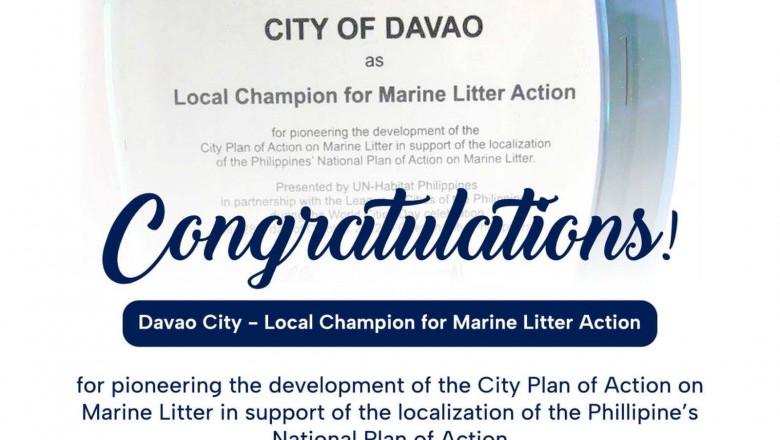

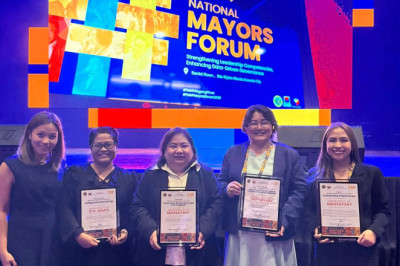
The award was given by the UN Habitat of the Philippines, in partnership with the League of Cities of the Philippines during the World Cities Day Celebration held on October 28, 2022, in Quezon City, Philippines.
Ancillary Services Unit (ASU) officer-in-charge Paul Bermejo said the city earned the honor for being able to implement a localized Philippine action plan for marine litter among other local government units (LGUs) in the country.
The award was attributed to the city's Bantay Dagat program, which started in 2017 during the administration of former Mayor Sara Duterte and has been continued by current Mayor Sebastian Duterte.
Bermejo cited Executive Order (EO) No. 41, Series of 2017, which provides that the Bantay Dagat volunteers will conduct coastal and riverbank cleanup every first and third Saturday morning of the month.
However, he said the 350 Bantay Dagat volunteers hold cleanup activities every Saturday morning in seven riverbanks and 26 coastal barangays.
Each volunteer receives P1,000 allowance.
Currently, he said other stakeholders and force multipliers from non-government organizations and the youth have been joining the weekly cleanup, as well as the barangay officials and their functionaries, City Environment and Natural Resources Office (CENRO) and Department of Natural Environment and Natural Resource Office (DENR) Region 11 staff, cyclists, teaches, boy scouts, and girl scouts, among others.
"This program is attributed to the City Government of Davao because even though the UN Habitat's Save the Oceans and Rivers has not been organized yet, we already have a program to clean our coastline,” Bermejo said in a report from the City Information Office.
The Bantay Dagat volunteers are grouped into clusters.
Cluster 1 comprises barangays 2A, 5A, 8A, 9A, and 10A while Cluster 2 included barangays 21-C, 32-C, 33-C, 31-B, 27-C, and 76-A.
The rest of the clusters: 4 - Matina Aplaya, Talomo, Bago Aplaya, Dumoy; 5 - Leon Garcia, Lapulapu, Centro Agdao, Duterte; 6 - Hizon, Pampanga, Sasa, Panacan; 7- Tibungco, Ilang, Bunawan, Lasang; 8 - Daliao, Lizada, Sirawan, Binugao.
For NGOs and other establishments or institutions wanting to participate in weekly cleanup as a community outreach activity, Bermejo said they could visit him at the ASU office inside the Maa slaughterhouse compound since they document their volunteers.
Interested groups and individuals who are joining cleanups must wear appropriate clothes, wear gloves, use thongs or sticks or hooks to pick up the garbage and bring empty sacks where to put the waste they have gathered.
ASU and CENRO are responsible for proper disposal of the collected wastes.
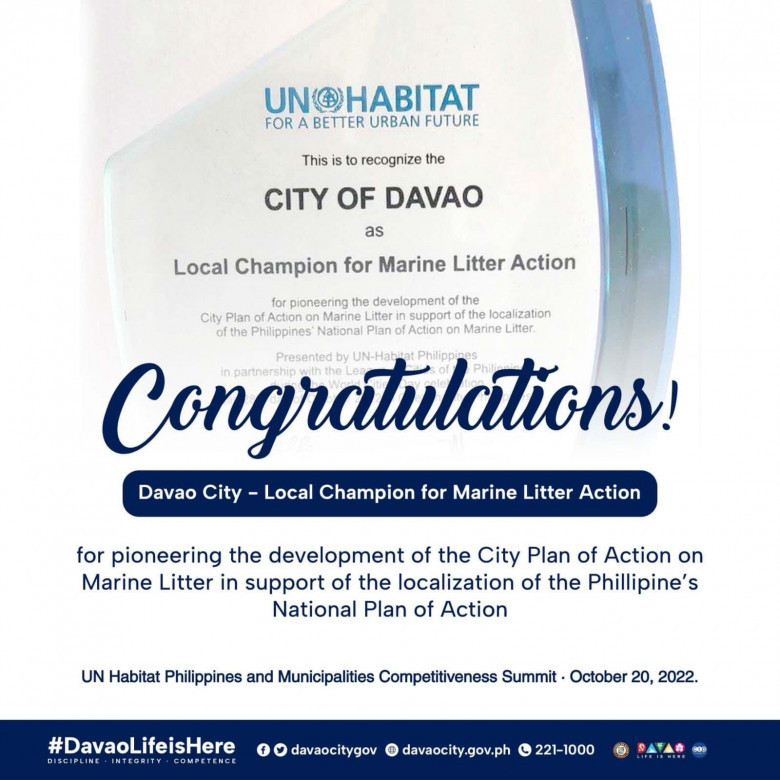 Photo from Davao City Government






Facebook Conversations